
The World's Only Private Safari Heritage Reserve

THE HISTORY OF CHIBEMBE
160 years.
One confluence.
From Livingstone’s crossing in 1866 to the opening of the reserve in 2026 — every chapter turns on the same fixed point in space.
1866 David Livingstone crosses the Luangwa at Perekani
The earliest recorded European visitor to this stretch of the river passes just north of what would become Chibembe. The ground that would later produce the walking safari was already on the map of African exploration.
1904 Luangwa Game Park established
The valley gains formal protected status — the precursor to South Luangwa National Park.
1932 Chibembe, unnamed as a campsite at the time, established as a hunting safari camp at the confluence of the main Luangwa and Chibembe channels
The first organised safari use of this ground. For more than two decades, this stretch of the Luangwa serves the hunting safari trade.
1955 Government survey records the Chibembe pontoon crossing
The Luangwa Valley Development Unit, formed under Ranger W.E. Poles, documents the construction of a pontoon crossing at Chibembe and Lion Camp with viewing tracks on the west bank.
"A seasonal pontoon crossing built across the Luangwa at Chibembe to permit access from the east. Lion Camp and viewing tracks built." — Luangwa Valley Development Unit record, 1955.
The infrastructure is established in the Chibembe area to develop tourism.
1960-61 Norman Carr pioneers the walking safari
On retirement from government, Carr and partner Peter Hankin establish Luangwa Safaris to operate hunting safaris in the Chibembe area. Softness in this operation leads to Carr developing other commercial safari ventures: Wilderness Trails is formed and the first commercial walking safari takes place from the Chibembe pontoon area.
1961 Wilderness Trails incorporates Lion Camp into its walking safari vision
"Lion Camp leased to Luangwa Safaris, directed by N.J. Carr, from which Wilderness Trails was pioneered as a type of tourism." The walking safari has a birth certificate — and walking safari origin is established around the Chibembe infrastructure built by W.E. Poles. The 1961 Northern Rhodesia government archive confirms it explicitly. Carr had spent decades on foot as a ranger in the Chibembe area; the wildlife here was so present that a vehicle felt beside the point. He got out. He walked. The Chibembe area - essentially the pontoon and surrounding island areas down to Lion Camp 9 miles away - was simply the place where it became undeniable to anyone who visited.
1968 Norman Carr builds Chibembe Safari Camp
On the east bank of the Luangwa, Carr establishes Chibembe Safari Camp — the operational heart of the Wilderness Trails walking safari circuit. This is the camp where the great guides of the next generation learn their craft. The circuit that Phil Berry, Robin Pope, and John Coppinger carry to the world runs from this confluence. The Chibembe area where the origin of the walking safari began is finally formalized into a camp located at its hub.
1975-77 Chibembe at the height of the walking safari circuit
The original Chinzombo Camp is established as a green season extension to Chibembe — confirming Chibembe's status as the primary dry-season heart of the Wilderness Trails operation. Norman Carr publishes a description of a six-day walking safari departing from Chibembe, crossing the Luangwa using Poles' 1955 pontoon — confirming in his own words that this ground is where the walks depart from.
1975-1990s The great guides of Chibembe
Phil Berry, Robin Pope, and John Coppinger live and work at Chibembe. The ground that produced the walking safari produces the guides who define the entire South Luangwa safari industry.
2023 Chibembe Wildlife Reserve established
The 345 hectare titled area known as Chibembe Wildlife Reserve bought directly from Wilderness Trails Limited — the company Norman Carr founded in 1961 and from which Wilderness Trails' walking safaris "were pioneered as a type of tourism." The chain of custodianship from the origin of the walking safari to the current owners is unbroken. Scout patrols deployed immediately. The ground where the walking safari reached its mature form and operated for decades returns to active private operation and conservation.
1990s-2022s The Wilderness Trails circuit breaks up
Investor Group acquires Wilderness Trails from Norman Carr. Overtime the Wilderness Trails camp circuit unwinds. Chibembe reverts into a self-drive small safari operation and its walking safari heritage lies largely dormant for years.
2025 Chieftainess Mwanya grants the Kalovia Island lease
After two years of earned trust, Chieftainess Mwanya in conjunction with Mwanya's Community Resource Board grants the Kalovia Island lease — approximately 2,500 acres of pristine wilderness that enlarges the reserve. Not negotiated. Granted. Chibembe Wildlife Reserve now holds 3,500 unfenced acres of one of the most storied wildlife areas in the valley.
JUNE 2026 Chibembe opens to guests
The ground where the walking safari was born — protected, restored, and held in the hands of a humbled owner who first came to the Luangwa Valley in 1984 when he fell in love with its people and wildlife — receives its first paying guests. The confluence remains. The wildlife remains. The legacy created by the walking safari pioneers continues.
SELECTED LANDMARKS

THE RIVER
The Chibembe-Luangwa Confluence
The fixed geographical point around which every chapter of this story turns. Where two rivers meet. Where the walking safari was born.

1955 - 2026
The Birth Certificate
"A seasonal pontoon crossing built across the Luangwa at Chibembe to permit access from the east. Lion Camp and viewing tracks built." The government record that gives the walking safari its documented origin.
THE TRADITION
The Walk Continues
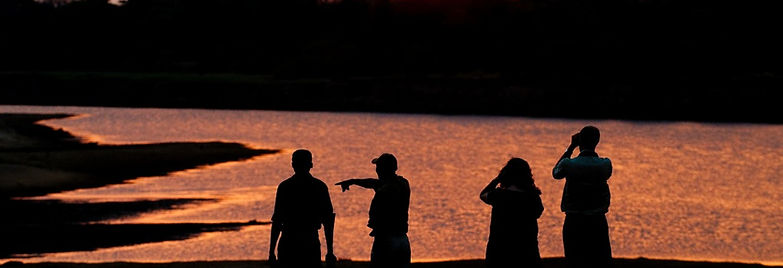
The walking safari, practiced here as it was first intended — not as a supplementary activity, but as the primary mode of engaging with the wild.

2025
The Gift of Kalovia
Chieftainess Mwanya grants the Kalovia Island lease — not negotiated, but earned. The same relationship Norman Carr first built with Chief Mwanya fifty years earlier, honoured again.
The Birth Certificate
