
The Birth Certificate of the Walking Safari
Updated: Jul 6
A government record from 1955, a named ranger, and the unbroken documentary chain that leads from a pontoon crossing at Chibembe to the walking safari as a form of tourism.
Mwanya Chiefdom, Luangwa Valley, Zambia · June 2026

Luangwa Valley Development Unit record, 1955. The documented origin of the walking safari at Chibembe.
In 1955, a Luangwa Valley Development Unit was formed under the command of Ranger W.E. Poles. Among the infrastructure it built that year:
A seasonal pontoon crossing built across the Luangwa at Chibembe to permit access from the east. Lion Camp and viewing tracks built.
Luangwa Valley Development Unit record, 1955 — Ranger W.E. Poles
That is the complete entry. A pontoon crossing. Access from the east. Lion Camp. Viewing tracks.
Not a hunting camp. Not a patrol post. Viewing tracks — infrastructure built specifically and explicitly for the purpose of viewing wildlife. At a site called Chibembe. By a named government ranger, in a named government unit, in a year that is not approximate.
That document is the birth certificate of the walking safari.
Why This Record Matters
The history of South Luangwa’s safari industry is told mostly in secondary sources — guidebooks, travel retrospectives, operator websites. Norman Carr pioneered the walking safari. South Luangwa is its birthplace. These claims appear everywhere, usually undated and almost never supported by a primary document.
This is a primary document. A government record. A named ranger. A specific year. Viewing tracks. A pontoon crossing built to access them.
It is also not the only entry that matters. The same archive contains this, for 1961:
Lion camp leased to ‘Luangwa Safaris’, a director of this company was N.J. Carr; from this camp Wilderness Trails were pioneered by Carr as a type of tourism.
Government archive record, 1961 — Luangwa Valley Development timeline
The chain is now complete and unbroken. 1955: the Luangwa Valley Development Unit builds Lion Camp and viewing tracks, connected to the east bank by a pontoon at Chibembe. 1961: Lion Camp is leased to N.J. Carr’s company, and from it Wilderness Trails are pioneered as a recognised type of tourism. The documentary lineage from Chibembe to the walking safari is not inferred. It is recorded.
The Geography of the Birth Certificate
The 1955 record names the pontoon at Chibembe specifically because the geography demanded it. The access roads came from Fort Jameson on the east side of the valley — the government record says so explicitly: “to permit access from the east.” Tourists arrived on the east bank. The pontoon crossed them to the west bank, where Lion Camp and the viewing tracks were newly built.
Without the Chibembe pontoon, there is no Lion Camp tourism. Without the east bank as the arrival point, there is no circuit. When Luangwa Safaris formed in 1961, Peter Hankin brought the east bank hunting camp near the pontoon into the company — the first camp in what became the Wilderness Trails circuit. Carr leased Lion Camp on the west bank — the second camp, the new frontier the pontoon had opened. The walking safari circuit ran between those two points, nine miles apart. Chikoko and other bush camps developed as nodes along the route.
The Chibembe corridor — east bank to west bank, arrival point to wilderness destination, nine miles of the most wildlife-dense river frontage in Africa — was Wilderness Trails. The east bank at Chibembe is where the road ended and the safari started.
The Archive in Full
The government record that contains the 1955 Chibembe entry is not an isolated document. It is a year-by-year account of the Luangwa Valley’s development — a running record kept by rangers and administrators across decades. Reading it places the 1955 entry in its full context:
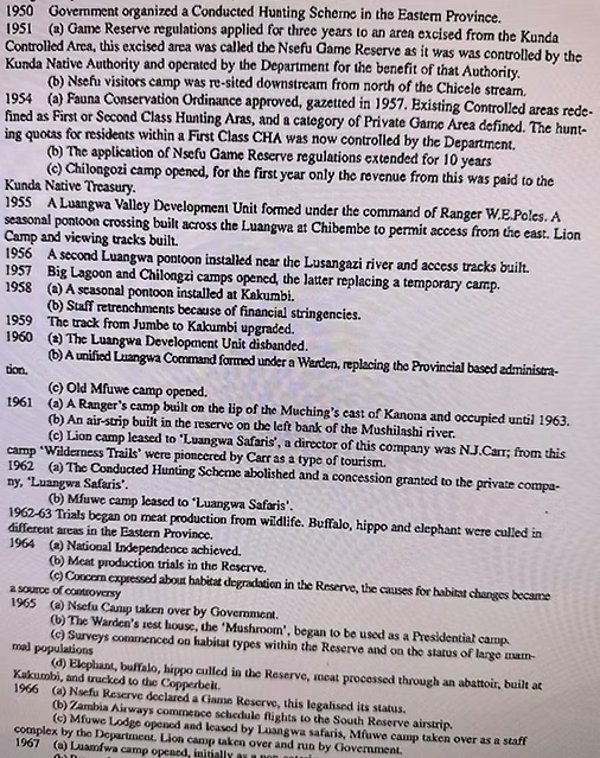
The government archive. The 1955 Chibembe entry sits in a sequence that runs from the 1950 Conducted Hunting Scheme through the 1961 pioneering of Wilderness Trails under N.J. Carr. The chain is unbroken.
Several entries are worth noting alongside the 1955 record:
1951 — The Nsefu Game Reserve established as a controlled area under the Kunda Native Authority. The first photographic tourist camp in the valley opens in Chief Nsefu’s area. Game viewed rather than shot. Revenue returned to the community. A chief’s voluntary decision to protect rather than harvest.
1953 — The Nsefu visitors camp re-sited downstream. Early development, but distinct from the 1955 Chibembe record: a named government body, a named ranger, and infrastructure explicitly built for viewing.
1955 — The Luangwa Valley Development Unit, under Ranger W.E. Poles, builds the Chibembe pontoon on the east bank and Lion Camp with viewing tracks on the west bank.
1961 — Lion Camp leased to Luangwa Safaris, directed by N.J. Carr. Wilderness Trails pioneered as a type of tourism from the Chibembe corridor.
Norman Carr and the Confluence
Norman Carr came to the Luangwa Valley not as a guest but as a game ranger. He spent years learning this landscape professionally — on foot, in terrain most visitors would never see. The confluence at Chibembe, where the main Luangwa channel and the Chibembe Channel converge, was not a discovery for him. It was a place he knew.
The confluence backs up both channels every wet season and floods north across the floodplain, depositing silt across the wafwas and grasslands and riverine forest above it. The wildlife concentration that results is not seasonal luck. It is geological logic — the same annual renewal that has been operating at this confluence for millennia, that drew Carr here, and that draws every elephant, buffalo, and lion that moves through the northern sector today.
The Chibembe area was simply the place where it became undeniable to anyone who visited. The wildlife was so present that a vehicle felt beside the point. He got out. He walked. And what his guests experienced was what he had always known: that you sense what animals on the hoof sense only by walking among them. The wind direction. The tracks pressed into sand. The alarm call of an impala forty seconds before the predator appeared. A vehicle insulates you from all of it. Feet on the ground do not.
The Name Came Last
By 1968, Norman Carr built a camp on the east bank and named it Chibembe — simply acknowledging what the ground had always been. The pontoon was here since 1955. The circuit had radiated from this confluence for over a decade. The camp name was the last thing to arrive.
The name Chibembe Safari Camp, when Norman Carr finally built it in 1968, was the last note in a song that had been playing since 1955. The government record that year named the pontoon at Chibembe — and in doing so gave this nine-mile corridor its birth certificate. The hunting camp followed. The walking safari followed. The circuit followed. The great guides followed. The camp that bore the name was simply the moment the world caught up to what the ground had always been.
The Guides Who Followed
The confluence did not only produce a method. It produced a culture.
Phil Berry, Robin Pope, John Coppinger — the guides who would define South Luangwa’s safari identity for decades — lived and worked at Chibembe. They learned this valley from this ground, from the man who first understood what the annual flood made possible. The guiding traditions that distinguish South Luangwa from every other safari destination in Africa — the pace, the attentiveness, the reading of a landscape on foot — trace directly to what was being practiced at this confluence.
The walking safari as practiced at its origin — on this ground, in this corridor, by guides whose entire professional formation happened here — is not remotely comparable to what happens when a lodge elsewhere in Africa adds a bush walk to the morning schedule. The form spread. The substance — the guiding depth, the landscape literacy, the specific knowledge of terrain that makes a walking safari genuinely transformative — largely did not. That depth lives here. It was forged here.
The Bushcamp Company has operated camps inside South Luangwa National Park for 25 years and manages Chibembe as part of its portfolio. It carries that lineage forward — in the guides it trains, the ground it knows, and the walking safari tradition it continues across the valley’s most remote terrain.
The Bushcamp Company — 25 Years Running Camps Inside South Luangwa National Park — bushcampcompany.com
Why It Matters Now
Chibembe Wildlife Reserve was established in 2023 on this same ground — the site that the 1955 government record documents, the site that Norman Carr walked, the site where the great guides of the Luangwa learned their craft. Acquired directly from Wilderness Trails Limited — the corporate successor to Norman Carr’s original walking safari operation. The chain of custodianship from the origin of the walking safari to the current owners is unbroken.
It is protected, patrolled by local scouts from Mwanya Chiefdom, and managed as a private wildlife reserve built on the same principle Carr articulated on this ground more than seventy years ago:
The wildlife will last only as long as the people beside it have reason to want it to.
The wildlife is still here. The wafwas are still fed by the annual flood. The buffalo still move across the silt-renewed floodplain. The confluence still backs up both channels every wet season and spreads north, renewing everything above it.
The 1955 government record remains what it has always been: a dated, primary-source document, written by a named ranger, recording the construction of viewing infrastructure at a named site.
Chibembe is not a camp that became significant. It is a place that was always significant — and eventually got a name.

chibembewildlifereserve.com · A Safari Heritage Site · Where the Walking Safari Began
PRIMARY SOURCES
The two foundational government entries that document the origin of the walking safari at Chibembe come from the official records of the colonial-era Game and Tsetse Control Department. These entries were compiled by W. L. Astle, a career government scientist who worked extensively in the Luangwa Valley. Astle served the Northern Rhodesian and Zambian governments from 1959 to 1973, spending six years in the valley as a biologist before becoming Chief Wildlife Research Officer. His account is drawn directly from the primary government records kept by rangers and administrators — not from secondary sources.
W. L. Astle, A History of Wildlife Conservation and Management in the mid-Luangwa Valley, Zambia (British Empire & Commonwealth Museum, 1999).
1955 Entry — Luangwa Valley Development Unit record “A Luangwa Valley Development Unit formed under the command of Ranger W.E. Poles. A seasonal pontoon crossing built across the Luangwa at Chibembe to permit access from the east. Lion Camp and viewing tracks built.”
1961 Entry — Government archive timeline “Lion camp leased to ‘Luangwa Safaris’, a director of this company was N.J. Carr; from this camp ‘Wilderness Trails’ were pioneered by Carr as a type of tourism.”
These records are corroborated by the Northern Rhodesia Annual Reports of the Department of Game and Tsetse Control (His/Her Majesty’s Stationery Office, London) and by the biographical record in Alistair Tough, Norman Carr: Pioneer of Community-based Wildlife Conservation. Norman Carr’s own accounts appear in his memoirs, The White Impala and Return to the Wild. Independent corroboration is also found in Dalal-Clayton & Child, Lessons from Luangwa (IIED, 2003).
The full documentary chain and archival context are available in our Heritage Note: Chibembe - The Ground Zero of the Walking Safari. (Safari Heritage Group, 2026).

Comments